What Is a Needle Valve?
In industrial instrumentation systems, precise flow control is essential for safety, efficiency, and process accuracy. A needle valve is designed to regulate flow with a high level of precision, making it a popular choice in applications where small flow adjustments are required.
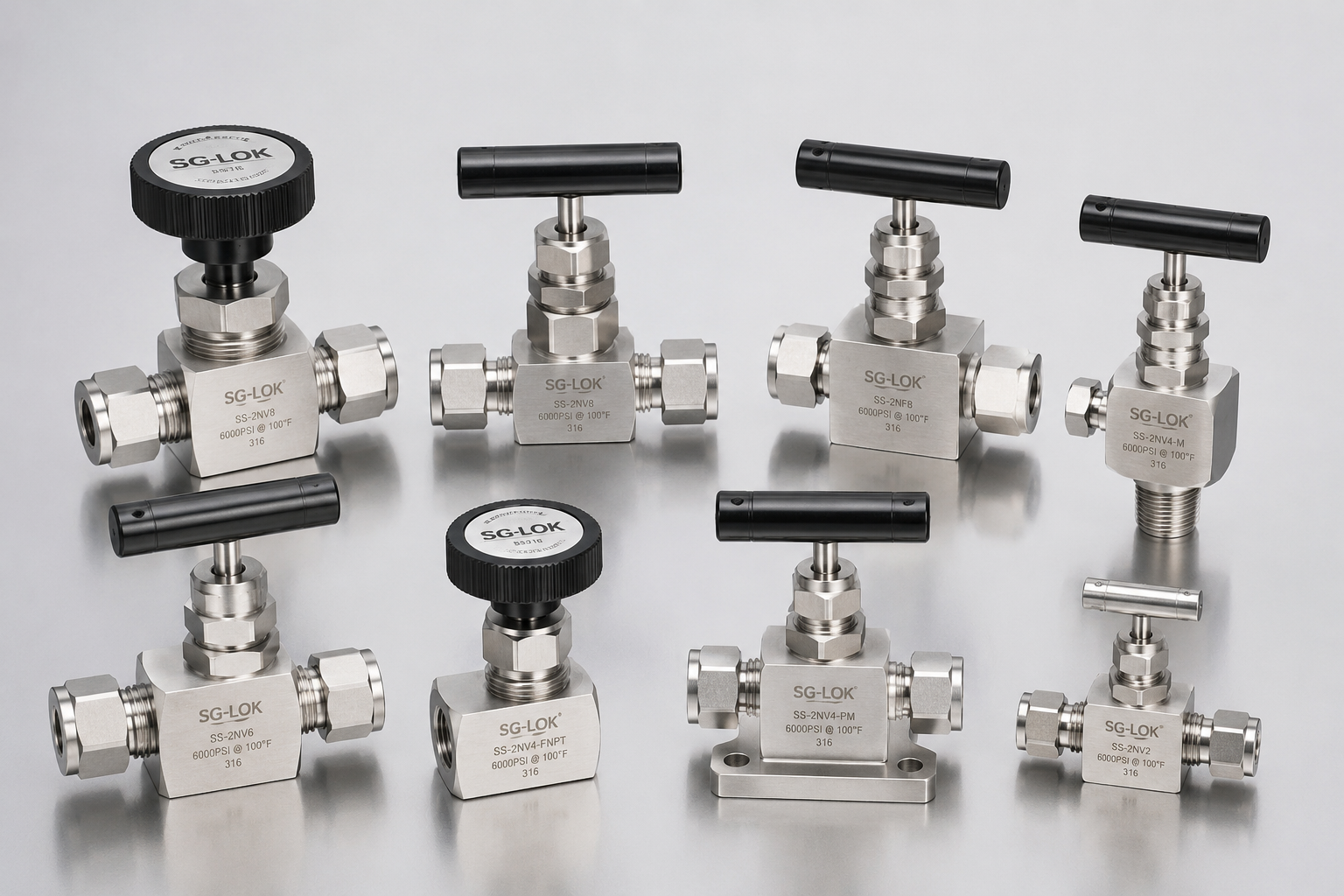
SG-LOK needle valves are manufactured to provide reliable shut-off performance, smooth operation, and long service life, even in demanding environments.
How Does a Needle Valve Work?
A needle valve uses a long, tapered stem (the “needle”) that moves into or out of a matching seat when the handle is turned.
As the needle moves:
- Turning the handle clockwise reduces the flow until it is completely shut off.
- Turning it counterclockwise gradually increases the flow.
This design allows operators to make very fine flow adjustments compared with standard ball valves.
Main Components of a Needle Valve
A typical SG-LOK needle valve consists of:
- Valve Body
- Stem
- Needle Tip
- Seat
- Packing
- Bonnet
- Handle
Each component is manufactured to maintain reliable sealing and smooth operation under pressure.
Advantages of a Needle Valve
Excellent Flow Control
Needle valves provide accurate adjustment of low flow rates.
Reliable Shut-Off
The tapered needle creates a tight seal when fully closed, helping to minimise leakage.
High Pressure Capability
Many instrumentation systems operate under high pressure, making needle valves a dependable solution.
Long Service Life
Quality materials and precision machining help ensure durability in demanding industrial environments.
Easy Maintenance
The simple design allows routine maintenance and replacement of wear parts when required.
Common Applications
SG-LOK needle valves are widely used in:
- Oil & Gas
- Petrochemical Plants
- Chemical Processing
- Power Generation
- Water Treatment
- Pharmaceutical Manufacturing
- Semiconductor Industry
- Laboratory Systems
- Instrument Air Systems
- Hydraulic and Pneumatic Systems
Needle Valve vs Ball Valve
| Needle Valve | Ball Valve |
|---|---|
| Precise flow control | Fast ON/OFF operation |
| Suitable for gradual adjustment | Best for full open or full close |
| Ideal for instrumentation | Ideal for general isolation |
Both valves are important, but they are designed for different purposes.
How to Choose the Right Needle Valve
Before selecting a needle valve, consider:
- Operating pressure
- Operating temperature
- Type of fluid or gas
- Required flow rate
- Connection type
- Material compatibility
- Installation environment
Choosing the correct valve helps improve performance and reduce maintenance costs.
Why Choose SG-LOK Needle Valves?
SG-LOK needle valves are designed for dependable performance in industrial instrumentation systems.
Key features include:
- Precision-engineered design
- Smooth flow adjustment
- Reliable leak-tight sealing
- High-quality stainless steel construction
- Suitable for demanding industrial applications
- Wide range of connection sizes and configurations
Conclusion
Needle valves play an important role in industrial systems where accurate flow control is required. By selecting a high-quality valve that matches your application, you can improve system performance, reduce downtime, and enhance operational reliability.
SG-LOK offers a range of precision-engineered needle valves designed to meet the needs of modern industrial instrumentation.